

There Are No Qualified Leads Without Qualified Decisions.
“Precision Targeting” is one of the most expensive phrases in presale marketing.
Not because targeting doesn’t matter.
But because most teams never define what “qualified” actually means.
If a lead doesn’t convert, what exactly was “qualified” about it? Just because Jim Wong is a 50 year-old Chinese man doesn’t mean he’s in the market for a home.
In a slower market, that confusion doesn’t just waste budget.
It slows absorption.
I. The real problem
Most presale teams don’t have a lead shortage.
Traffic comes in. Inquiries happen. Events get attendance. Sales teams follow up.
Yet on Monday morning, you still can’t answer one question with confidence:
What matters most this week—and what are we doing about it?
So the team defaults to the industry’s comfort blanket:
“Let’s improve lead quality.”
It sounds strategic.
It usually isn’t.
II. Why smart teams keep getting stuck
Here’s the mechanism that traps smart VPs and directors:
1) “Qualified” becomes a demographic profile.
Investor vs end-user.
Local vs overseas.
Age. Income bracket. Language.
Those are static descriptors—not buying decisions.
They describe who someone is, not how close they are to committing.
2) Marketing and sales get split by a fake boundary.
The company centric buyer journey is:
Ad → Click → Lead → Sales → Deal
Marketing “generates leads.”
Sales “converts leads.”
But buyers don’t experience your org chart.
They experience one continuous journey:
Conflict → Pain Point → Expectation → Options → Comparison → Decision
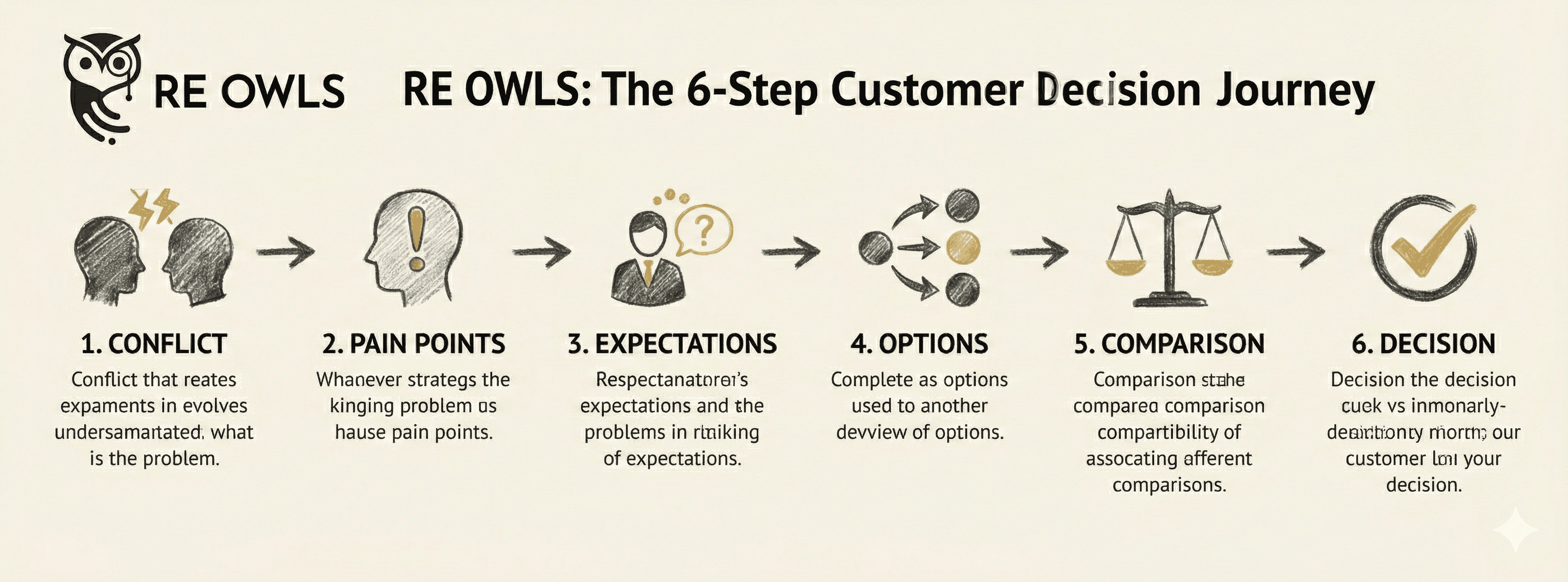
When teams optimize in silos, the buyer experiences inconsistency—often without being able to articulate why trust erodes.
3) When conversion stalls, teams blame the wrong layer.
“If they inquired but didn’t buy, our follow-up scripts must be the issue.”
So you:
Drop prices.
You retrain reps.
You add nurture sequences.
Sometimes that helps.
But more often, the real issue is upstream:
your system never produced a credible, consistent reason to choose you—across the entire journey.
You didn’t generate qualified leads.
You generated attention.
Attention is not intent.
Intent is not commitment.
And commitment requires trust.
III. The model: from lead thinking to absorption thinking
RE Owls is built around a simple premise:
Developers don’t need more software. They need a revenue brain.
A System of Insight that turns first-party data into:
Ranked priorities (what matters most, in order)
Cleaner funnels (less waste, fewer handoff failures)
Faster absorption (measurable revenue impact)
This is outcomes-first, not feature-first.
The most useful definition of “qualified” in presale is not “who they are.”
It’s:
How close they are to a decision—and what’s blocking it.
That closeness shows up in behavior.
In early phases — especially where tracking is limited, you can still extract meaningful first-party signals from the interactions you do control:
AI Concierge/chatbot usage
Conversation topics and questions
Engagement timing and frequency
Attribution signals (including ad account access where available).
A simple hypothetical:
You receive 600 inquiries this month.
Lead quality thinking says:
“Let’s narrower audience.”
Absorption thinking says:
“Identify the 60 with the strongest decision signals, surface the top friction patterns, and prescribe next actions—ranked—so your team stops guessing.”
IV. The practical playbook: how to apply this now
If you’re a CEO, VP, or Sales/Marketing Director, here’s how to apply this without waiting for a perfect data warehouse.
Step 1 — Define “qualification” as a conversion event, not a persona.
Agree on 4–7 journey stages .
Examples:
Inquiry → Conversation → Appointment → Visit → Offer → Deposit.
Your language can differ. The point is shared definitions.
Rule of thumb: If two leaders disagree on stage definitions, you’re not running a funnel—you’re running opinions.
Step 2 — Inventory only your first-party signals.
Not everything. Just what you can reliably capture.
Conversation topics and questions (from chatbot + rep notes)
Timestamps (when engagement happens)
Source information (where they came from)
Repeated behaviours (return visits, repeat questions)
Step 3 — Build a weekly Ranked Priority Board.
One page. Ten items max.
Each item must include:
Signal → Diagnosis → Next action → Owner → Due date
This forces the organization to stop treating marketing as “content output” and sales as “follow-up volume.”
It turns revenue operations into a scalable decision engine.
Step 4 — Standardize handoffs with explicit rules.
When behavior X happens, sales does Y within Z time.
When marketing sees pattern A, it changes message B—not just budget.
Step 5 — Design for trust, not clicks.
If your public-facing content is generic, your private follow-up can’t magically “convert” it.
Buyers don’t get convinced at one moment.
They get convinced by consistency.
V. The decision
This week, you have a choice:
Keep optimizing “lead quality” as a belief.
Or install a decision system that produces ranked clarity.
Because the teams that win in a slow presale market aren’t the ones with the most leads.
They’re the ones who can say:
“Here are our top priorities this week, in order—and here’s what we’re doing about them.”
That’s not better marketing.
That’s better thinking.